Last updated October 2026.
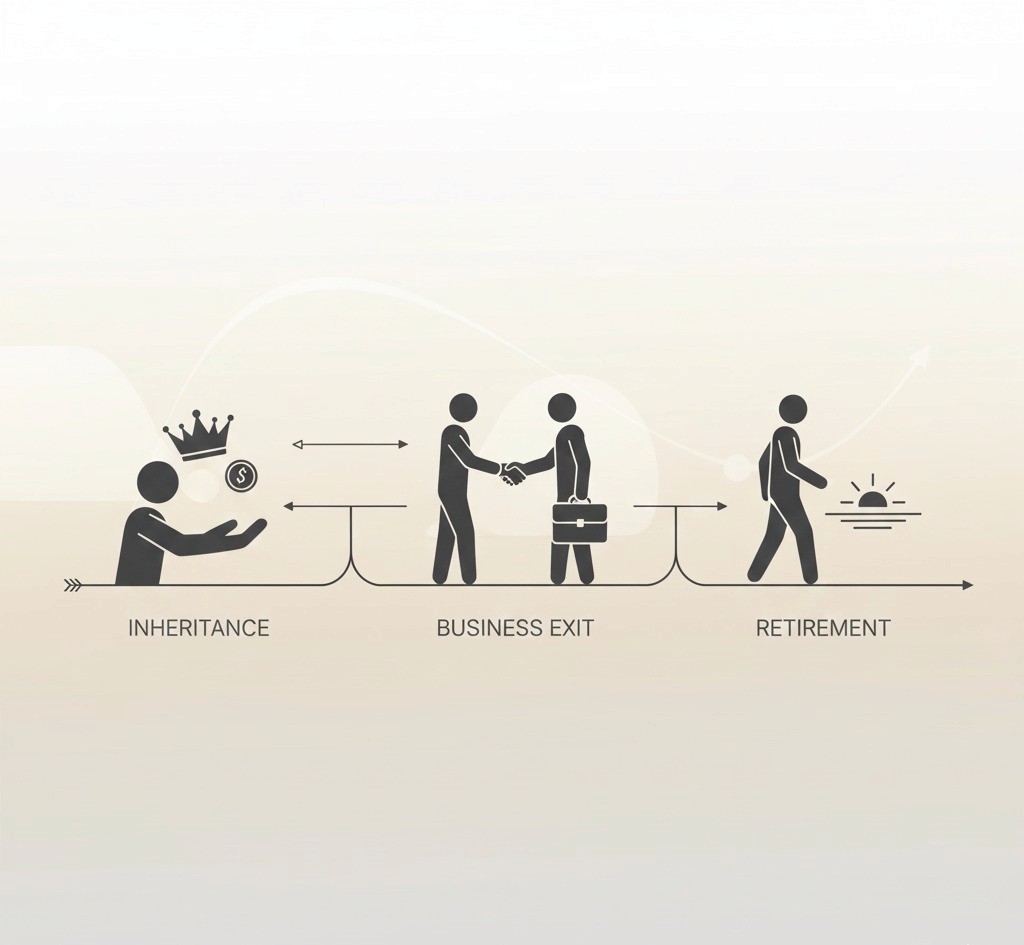
A client receives an inheritance, sells a business, or retires. The balance in the account can stay almost the same. The person holding it rarely does. The way they think about risk, time and control changes, and it changes quickly.
That makes a transition one of the most useful moments in a client relationship. It also makes it easy to misread if you are only looking at the numbers.
How Does Investment Behavior Change During Wealth Transitions?
In one line: the client stops building wealth and starts deciding what the wealth is for. The trigger is not the size of the amount. It is how the money arrived and what the client wants it to do next.
An heir and a founder can land on the same balance and behave nothing alike. Getting the trigger right matters more than getting the total right.
Why the Trigger Matters More Than the Amount
Money carries a story with it. A founder who spent twenty years building a company has a relationship with control that does not switch off on the day of the sale. An heir who received the same amount in a single transfer often wants the weight lifted, not a new project to run.
Same balance, opposite instincts. If your only input is the statement, you end up pitching the same thing to both.
What Changes and What Stays the Same
It helps to separate the moving parts from the fixed ones.
What changes:
The purpose of the money, from growth to a specific job.
The tolerance for volatility, usually downward.
The time horizon, which shortens for some goals and lengthens for others.
The questions the client asks, which get more personal and more specific.
What stays the same:
The underlying assets, at least at first.
The client's core values, which tend to sharpen rather than shift.
The need for a person they trust to help them think.
It is tempting to treat the whole relationship as changed. In practice only part of it moves, and that part moves fast.
How Inheritance Reshapes Investment Behavior
Inherited wealth arrives with grief, responsibility and, often, a steep learning curve. The new holder is managing capital they did not build and may feel watched by the person who left it.
The Early Phase Is About Safety and Understanding
Right after a transfer, most inheritors want to understand what they have before they change it. Speed feels reckless. A firm that pushes a product in the first meeting reads as a threat rather than a partner.
The useful move is to slow down and explain. Walk through what is there, what it produces, and what choices exist. The client is not stalling. They are orienting.
Then Comes Structure
Over the following months the questions shift. How should the capital be split? What should stay untouched? What can be put to work? This is where a behavioural read earns its place, because the heir's pace becomes the plan.
The Identity Question Underneath
Many inheritors are quietly deciding who they are with this money. A steward. A builder. Someone who gives it away. Firms that help answer that question keep the relationship for decades. Firms that ignore it stay transactional.
How a Business Exit Reshapes Investment Behavior
An exit concentrates a life's work into a single number and then ends it. That is a strange place to stand, and it explains most of the behaviour that follows.
The Sudden Need for Diversification
A founder who had everything in one company suddenly has everything in cash. The instinct is to redeploy, but not into another single bet. This is the moment portfolio construction finally matters, and it is the moment many founders become open to advice they ignored for years.
The Search for the Next Thing
Some founders want to back the next company the week after they sell. Others want nothing to do with risk for a while. Both are normal. The firm that can hold either path open, without judging it, tends to become the long-term partner.
Timing the Conversation
The best entry point sits well before the cash lands. Founder liquidity events are visible in advance, and an adviser who is in the room three months early gets to shape the plan instead of reacting to it.
How Retirement Reshapes Investment Behavior
Retirement is the transition everyone plans for and most people underrate. The behavioural change is bigger than the arithmetic one.
From Growth to Income
The mandate flips. A client who spent thirty years compounding now needs the portfolio to fund a life. That change in purpose moves every allocation underneath it.
The Fear of Running Out
The dominant feeling in retirement is not greed. It is the fear of outliving the money. A client who never worried about volatility can become highly sensitive to it almost overnight. Ignore that and every recommendation sounds tone-deaf.
Legacy Enters the Frame
Later in this phase, the client starts thinking about what happens after them. Estate conversations, succession, charitable intent. This is where the behavioural and the financial sides of a firm fully meet.
What the First Year Usually Looks Like
Transitions follow a rough arc, and knowing it helps you stay ahead of the client instead of chasing them.
Months one to three: the client is absorbing. They want to understand, not commit. Show up, explain, do not sell.
Months three to six: questions get specific. This is where a plan starts to take shape and where the relationship either deepens or stalls.
Months six to twelve: decisions get made. The client who trusted you in the quiet stretch now moves with you rather than around you.
The quiet middle is where most relationships are won or lost. It is also where most firms go silent.
Why Transitions Are Also Prospecting Moments
Every transition is a decision point, and decision points move money. A client is most likely to change advisers in the months around a major event.
That makes these moments the highest-value time to be present. Event-triggered prospecting works because it watches for the transition instead of waiting for the resulting account to appear somewhere.
The same logic runs on the prospecting side. A rising HNI going through an early wealth event is both newly affluent and newly open to a conversation.
How to Read the Shift Before the Portfolio Does
The signals are there for a firm that tracks them.
A liquidity event on the calendar, seen in advance.
A change in behaviour: slower replies, faster ones, different questions.
New people entering the client's circle, often advisers from the previous generation.
A change in what the client calls the money: "my portfolio," "my parents' estate," "the family's capital."
None of that shows up in a statement. All of it shows up in a 360 profile built from more than financial data.
How to Prepare Before the Transition Happens
You do not have to wait for the event to be ready for it.
Know which clients have a liquidity event on the horizon, and when.
Keep notes on the client's goals, so the transition has context the day it starts.
Build the relationship with the next generation early, not at the reading of a will.
Stay in touch through steady periods, so the first call after a transition is not a reintroduction.
Preparation is mostly about attention paid before there is anything to sell.
How to Use This With a Client, Step by Step
Transitions reward preparation more than speed. The first conversation after an inheritance, an exit, or a retirement date is not the moment for a full allocation proposal. It is the moment to get the new context on record.
Confirm what actually happened. A signal on a feed is a starting point, not a fact. Confirm the event, the timing, and how much of the money is liquid before any planning starts.
Ask what the money is for now. The purpose question matters more than the asset question. A client funding a child's education, a founder keeping dry powder for a second company, and a retiree protecting a lifestyle all hold the same portfolio differently.
Slow the allocation down. Large moves in the first weeks of a transition usually come from discomfort, not analysis. Parking arrangements exist for exactly this window. Let the behavior settle before the strategy changes.
Write the new context down where the team can use it. The origin of the money, the client's stated purpose, the pace they want to move at. A transition that lives in one person's memory gets reinterpreted from scratch by the next person who touches the relationship.
Set the review point before you leave the meeting. The sharp phase of a transition passes. Book the conversation for after it does, when the client has had time to see their own pattern.
How to Talk to a Client Mid-Transition
The words matter as much as the plan. A client in the middle of a transition is often deciding, for the first time, what kind of relationship they want with their money. How a firm shows up in that stretch tends to set the tone for years.
Name the Moment
Say what you see. "This is a big change, and the first year is usually about getting comfortable, not moving fast" lands better than any product discussion. The client relaxes when they feel understood.
Ask Before You Advise
The most useful question in a transition is not "what should we buy." It is "what do you want this money to do?" The answer tells you the mandate, and the mandate tells you everything else.
Match the Pace, Not the Calendar
Firms often work to a quarterly cycle. Clients in transition work to an emotional one. Pushing a decision the client is not ready for costs more than waiting a month would have.
Keep Showing Up in the Quiet Stretch
Most relationships are lost in the silent middle, not at the event itself. A short check-in with no agenda does more for trust than a polished review meeting.
The Liquidity and Tax Layer
A transition is not only a behavioural moment. It is usually a tax and liquidity one too, and the two are linked.
Why Timing Shows Up in the Money
Whether a gain is realised this year or next, whether a sale is structured as a lump sum or a stream, whether proceeds sit in one entity or several, all of it changes what the client keeps. This is where an adviser earns their fee in a single conversation.
Why the Behaviour Comes First
You cannot structure a plan the client will not follow. A client who is afraid of running out will resist an aggressive structure no matter how good it is on paper. The behavioural read tells you which structure will actually be lived with.
Why Early Beats Clever
The best tax and liquidity outcomes usually come from being in the conversation before the event, not after. Once the cash has landed and the structure is fixed, the room to plan shrinks. Being early is worth more than being clever.
What Advisers Often Get Wrong
A few patterns show up again and again, and each one is avoidable.
Reading the balance and missing the person. The number is the least useful part of a transition.
Selling into the uncertainty. The moment a client is least sure is the worst moment to pitch.
Disappearing after the event. The quiet stretch is where trust is built, and it is where most firms go silent.
Treating all transitions the same. Inheritance, exit and retirement are different events with different needs.
Waiting for the client to ask. By the time they ask, they are often already talking to someone else.
Fix those five and the transition stops being a risk and starts being the firm's best opportunity.
Why This Matters More Than It Used To
Wealth used to accumulate slowly enough that firms could see it coming. A career compounded. A business grew. There was time.
That is no longer the only path. A single exit or a scheduled vest can move a household into a new category in weeks. The window between "steady client" and "client in transition" has shrunk.
When transitions happen faster, the firm that reads behaviour gets there while the decision is still open. The firm that waits for the statement is always reconstructing a conversation that already happened without them.
The First Twelve Months, Mapped
A transition has a shape you can plan around, and knowing which part of it you are in prevents most of the damage.
The first quarter is about safety and questions. The client wants to know nothing is broken. Liquidity is parked, tax work is sequenced, and the adviser is mostly listening. Advice offered here is remembered. Advice pushed here is resented.
The middle two quarters are where structure gets built. Entities are reviewed, goals are written down, and the portfolio starts reflecting the new purpose rather than the old accident.
The last quarter sets the long-term pattern. Allocation decisions made here tend to stick for years, because they are made from settled behavior instead of first-month nerves.
Most of the damage in transitions comes from doing quarter-three work in quarter-one. The framework tells you which quarter you are in; the discipline is acting like it.
FAQ
How does investment behavior change after inheritance?
Clients usually prioritise safety and understanding first, then move toward structure and diversification as they gain confidence. The pace matters more than the plan.
Why do founders behave differently after a business exit?
They move from one concentrated bet to a sudden need to diversify, and they often begin searching for a next venture. Both instincts are normal and both benefit from a patient adviser.
Why is retirement a behavioural shift, not just a financial one?
The mandate moves from growth to income and the client's main fear becomes outliving the money. That changes risk tolerance, communication and planning all at once.
What is the best moment to start the conversation?
Well before the event. A client preparing for a transition is far more open than one who has just finished it, and being present early is what shapes the plan.
How do you spot a transition in progress?
Watch the events and the behaviour together. A scheduled liquidity event plus a change in how the client communicates is the clearest signal you will get.
Does this only apply to existing clients?
No. Transitions are also the moment when people who have never used an adviser start looking for one. The same signals that help you serve a client help you find the next one.
How long does a transition last?
The sharp phase is usually six to twelve months. The behaviour it sets can last for years, which is why the early stretch matters so much.
Should the whole team be involved?
Yes, eventually. But the first conversations work best with one trusted person, so the client is not managing a room while they are managing a change.
When a transition starts, the firm that already knows the client gets to lead the conversation. See how Affluense surfaces these moments while there is still time to act.
Last updated October 2026.
A client receives an inheritance, sells a business, or retires. The balance in the account can stay almost the same. The person holding it rarely does. The way they think about risk, time and control changes, and it changes quickly.
That makes a transition one of the most useful moments in a client relationship. It also makes it easy to misread if you are only looking at the numbers.
How Does Investment Behavior Change During Wealth Transitions?
In one line: the client stops building wealth and starts deciding what the wealth is for. The trigger is not the size of the amount. It is how the money arrived and what the client wants it to do next.
An heir and a founder can land on the same balance and behave nothing alike. Getting the trigger right matters more than getting the total right.
Why the Trigger Matters More Than the Amount
Money carries a story with it. A founder who spent twenty years building a company has a relationship with control that does not switch off on the day of the sale. An heir who received the same amount in a single transfer often wants the weight lifted, not a new project to run.
Same balance, opposite instincts. If your only input is the statement, you end up pitching the same thing to both.
What Changes and What Stays the Same
It helps to separate the moving parts from the fixed ones.
What changes:
The purpose of the money, from growth to a specific job.
The tolerance for volatility, usually downward.
The time horizon, which shortens for some goals and lengthens for others.
The questions the client asks, which get more personal and more specific.
What stays the same:
The underlying assets, at least at first.
The client's core values, which tend to sharpen rather than shift.
The need for a person they trust to help them think.
It is tempting to treat the whole relationship as changed. In practice only part of it moves, and that part moves fast.
How Inheritance Reshapes Investment Behavior
Inherited wealth arrives with grief, responsibility and, often, a steep learning curve. The new holder is managing capital they did not build and may feel watched by the person who left it.
The Early Phase Is About Safety and Understanding
Right after a transfer, most inheritors want to understand what they have before they change it. Speed feels reckless. A firm that pushes a product in the first meeting reads as a threat rather than a partner.
The useful move is to slow down and explain. Walk through what is there, what it produces, and what choices exist. The client is not stalling. They are orienting.
Then Comes Structure
Over the following months the questions shift. How should the capital be split? What should stay untouched? What can be put to work? This is where a behavioural read earns its place, because the heir's pace becomes the plan.
The Identity Question Underneath
Many inheritors are quietly deciding who they are with this money. A steward. A builder. Someone who gives it away. Firms that help answer that question keep the relationship for decades. Firms that ignore it stay transactional.
How a Business Exit Reshapes Investment Behavior
An exit concentrates a life's work into a single number and then ends it. That is a strange place to stand, and it explains most of the behaviour that follows.
The Sudden Need for Diversification
A founder who had everything in one company suddenly has everything in cash. The instinct is to redeploy, but not into another single bet. This is the moment portfolio construction finally matters, and it is the moment many founders become open to advice they ignored for years.
The Search for the Next Thing
Some founders want to back the next company the week after they sell. Others want nothing to do with risk for a while. Both are normal. The firm that can hold either path open, without judging it, tends to become the long-term partner.
Timing the Conversation
The best entry point sits well before the cash lands. Founder liquidity events are visible in advance, and an adviser who is in the room three months early gets to shape the plan instead of reacting to it.
How Retirement Reshapes Investment Behavior
Retirement is the transition everyone plans for and most people underrate. The behavioural change is bigger than the arithmetic one.
From Growth to Income
The mandate flips. A client who spent thirty years compounding now needs the portfolio to fund a life. That change in purpose moves every allocation underneath it.
The Fear of Running Out
The dominant feeling in retirement is not greed. It is the fear of outliving the money. A client who never worried about volatility can become highly sensitive to it almost overnight. Ignore that and every recommendation sounds tone-deaf.
Legacy Enters the Frame
Later in this phase, the client starts thinking about what happens after them. Estate conversations, succession, charitable intent. This is where the behavioural and the financial sides of a firm fully meet.
What the First Year Usually Looks Like
Transitions follow a rough arc, and knowing it helps you stay ahead of the client instead of chasing them.
Months one to three: the client is absorbing. They want to understand, not commit. Show up, explain, do not sell.
Months three to six: questions get specific. This is where a plan starts to take shape and where the relationship either deepens or stalls.
Months six to twelve: decisions get made. The client who trusted you in the quiet stretch now moves with you rather than around you.
The quiet middle is where most relationships are won or lost. It is also where most firms go silent.
Why Transitions Are Also Prospecting Moments
Every transition is a decision point, and decision points move money. A client is most likely to change advisers in the months around a major event.
That makes these moments the highest-value time to be present. Event-triggered prospecting works because it watches for the transition instead of waiting for the resulting account to appear somewhere.
The same logic runs on the prospecting side. A rising HNI going through an early wealth event is both newly affluent and newly open to a conversation.
How to Read the Shift Before the Portfolio Does
The signals are there for a firm that tracks them.
A liquidity event on the calendar, seen in advance.
A change in behaviour: slower replies, faster ones, different questions.
New people entering the client's circle, often advisers from the previous generation.
A change in what the client calls the money: "my portfolio," "my parents' estate," "the family's capital."
None of that shows up in a statement. All of it shows up in a 360 profile built from more than financial data.
How to Prepare Before the Transition Happens
You do not have to wait for the event to be ready for it.
Know which clients have a liquidity event on the horizon, and when.
Keep notes on the client's goals, so the transition has context the day it starts.
Build the relationship with the next generation early, not at the reading of a will.
Stay in touch through steady periods, so the first call after a transition is not a reintroduction.
Preparation is mostly about attention paid before there is anything to sell.
How to Use This With a Client, Step by Step
Transitions reward preparation more than speed. The first conversation after an inheritance, an exit, or a retirement date is not the moment for a full allocation proposal. It is the moment to get the new context on record.
Confirm what actually happened. A signal on a feed is a starting point, not a fact. Confirm the event, the timing, and how much of the money is liquid before any planning starts.
Ask what the money is for now. The purpose question matters more than the asset question. A client funding a child's education, a founder keeping dry powder for a second company, and a retiree protecting a lifestyle all hold the same portfolio differently.
Slow the allocation down. Large moves in the first weeks of a transition usually come from discomfort, not analysis. Parking arrangements exist for exactly this window. Let the behavior settle before the strategy changes.
Write the new context down where the team can use it. The origin of the money, the client's stated purpose, the pace they want to move at. A transition that lives in one person's memory gets reinterpreted from scratch by the next person who touches the relationship.
Set the review point before you leave the meeting. The sharp phase of a transition passes. Book the conversation for after it does, when the client has had time to see their own pattern.
How to Talk to a Client Mid-Transition
The words matter as much as the plan. A client in the middle of a transition is often deciding, for the first time, what kind of relationship they want with their money. How a firm shows up in that stretch tends to set the tone for years.
Name the Moment
Say what you see. "This is a big change, and the first year is usually about getting comfortable, not moving fast" lands better than any product discussion. The client relaxes when they feel understood.
Ask Before You Advise
The most useful question in a transition is not "what should we buy." It is "what do you want this money to do?" The answer tells you the mandate, and the mandate tells you everything else.
Match the Pace, Not the Calendar
Firms often work to a quarterly cycle. Clients in transition work to an emotional one. Pushing a decision the client is not ready for costs more than waiting a month would have.
Keep Showing Up in the Quiet Stretch
Most relationships are lost in the silent middle, not at the event itself. A short check-in with no agenda does more for trust than a polished review meeting.
The Liquidity and Tax Layer
A transition is not only a behavioural moment. It is usually a tax and liquidity one too, and the two are linked.
Why Timing Shows Up in the Money
Whether a gain is realised this year or next, whether a sale is structured as a lump sum or a stream, whether proceeds sit in one entity or several, all of it changes what the client keeps. This is where an adviser earns their fee in a single conversation.
Why the Behaviour Comes First
You cannot structure a plan the client will not follow. A client who is afraid of running out will resist an aggressive structure no matter how good it is on paper. The behavioural read tells you which structure will actually be lived with.
Why Early Beats Clever
The best tax and liquidity outcomes usually come from being in the conversation before the event, not after. Once the cash has landed and the structure is fixed, the room to plan shrinks. Being early is worth more than being clever.
What Advisers Often Get Wrong
A few patterns show up again and again, and each one is avoidable.
Reading the balance and missing the person. The number is the least useful part of a transition.
Selling into the uncertainty. The moment a client is least sure is the worst moment to pitch.
Disappearing after the event. The quiet stretch is where trust is built, and it is where most firms go silent.
Treating all transitions the same. Inheritance, exit and retirement are different events with different needs.
Waiting for the client to ask. By the time they ask, they are often already talking to someone else.
Fix those five and the transition stops being a risk and starts being the firm's best opportunity.
Why This Matters More Than It Used To
Wealth used to accumulate slowly enough that firms could see it coming. A career compounded. A business grew. There was time.
That is no longer the only path. A single exit or a scheduled vest can move a household into a new category in weeks. The window between "steady client" and "client in transition" has shrunk.
When transitions happen faster, the firm that reads behaviour gets there while the decision is still open. The firm that waits for the statement is always reconstructing a conversation that already happened without them.
The First Twelve Months, Mapped
A transition has a shape you can plan around, and knowing which part of it you are in prevents most of the damage.
The first quarter is about safety and questions. The client wants to know nothing is broken. Liquidity is parked, tax work is sequenced, and the adviser is mostly listening. Advice offered here is remembered. Advice pushed here is resented.
The middle two quarters are where structure gets built. Entities are reviewed, goals are written down, and the portfolio starts reflecting the new purpose rather than the old accident.
The last quarter sets the long-term pattern. Allocation decisions made here tend to stick for years, because they are made from settled behavior instead of first-month nerves.
Most of the damage in transitions comes from doing quarter-three work in quarter-one. The framework tells you which quarter you are in; the discipline is acting like it.
FAQ
How does investment behavior change after inheritance?
Clients usually prioritise safety and understanding first, then move toward structure and diversification as they gain confidence. The pace matters more than the plan.
Why do founders behave differently after a business exit?
They move from one concentrated bet to a sudden need to diversify, and they often begin searching for a next venture. Both instincts are normal and both benefit from a patient adviser.
Why is retirement a behavioural shift, not just a financial one?
The mandate moves from growth to income and the client's main fear becomes outliving the money. That changes risk tolerance, communication and planning all at once.
What is the best moment to start the conversation?
Well before the event. A client preparing for a transition is far more open than one who has just finished it, and being present early is what shapes the plan.
How do you spot a transition in progress?
Watch the events and the behaviour together. A scheduled liquidity event plus a change in how the client communicates is the clearest signal you will get.
Does this only apply to existing clients?
No. Transitions are also the moment when people who have never used an adviser start looking for one. The same signals that help you serve a client help you find the next one.
How long does a transition last?
The sharp phase is usually six to twelve months. The behaviour it sets can last for years, which is why the early stretch matters so much.
Should the whole team be involved?
Yes, eventually. But the first conversations work best with one trusted person, so the client is not managing a room while they are managing a change.
When a transition starts, the firm that already knows the client gets to lead the conversation. See how Affluense surfaces these moments while there is still time to act.